Cheyenne
On the RoadCheyenne is both a literal junction and a test of the West’s promise in Sal Paradise’s travels. On his first journey in 1947, it is the place where a fast, exuberant ride across the plains ends in a staged Wild West celebration, and where Sal parts from the people who carried him there before hitchhiking south to Denver. Later journeys pass through or recall the same corridor, making Cheyenne part of the novel’s recurring geography of movement, return, and unfinished arrival.
Position on the Westward Route
Sal’s first trip begins with maps and a plan: he has studied Route 6 from the East and imagines stopping in Chicago and Denver before reaching San Francisco. The route becomes less a fixed itinerary than a sequence of rides and decisions. After joining a truckload of travelers heading west, Sal learns that the drivers will leave him at Cheyenne; from there, as one traveler explains, he can head toward Montana, while the truck itself is bound for Los Angeles. Sal weighs the tempting prospect of crossing Nebraska, Wyoming, and the Utah desert overnight, but chooses Denver, which lies about ninety miles south of Cheyenne. The stop therefore marks a genuine fork in his journey: the direct line to the Pacific yields to the pull of the friends he wants to find.
The journey gives the place its force before Sal arrives. A Minnesota farm family has picked up people on the road while transporting farm machinery, and their truck carries a shifting company of riders through Nebraska. The rough highway, with its soft shoulders and deep ditches, makes the vehicle bounce and teeter; one brother drives at the limit while the passengers pass a bottle and watch the plains open toward Colorado. Sal’s delight at finally looking toward Denver contrasts with the uncertainty of the ride and the dependence of every traveler on someone else’s vehicle, fuel, and choices. Cheyenne is not reached by a self-sufficient road hero but by a temporary community assembled in motion.
Wild West Week and the Parting
As the truck reaches Cheyenne, the travelers find the town in the middle of Wild West Week. Red radio-station lights and crowds along both sidewalks announce the celebration. Businessmen wear boots and ten-gallon hats, their wives dress in cowgirl outfits, blank guns go off, and the saloons fill to the sidewalk. The festivities concentrate on Oldtown, while the newer downtown stretches away under its boulevard lights. To Sal, the scene is at once striking and ridiculous: his first close encounter with the West’s proud traditions is a public performance of them, arranged as an attraction for crowds.
The stop is brief because the Minnesota drivers do not want to stay. Sal and his companions have to jump off and say goodbye, and he recognizes that he will probably never see them again. Their departure makes the festival more than a colorful interlude: the ride that carried Sal across the plains dissolves at the threshold of the West. One traveler accepts the cold night ahead rather than remain with the truck; the group’s different destinations separate them. The road’s promise of company is real, but temporary, and every arrival carries the prospect of another parting.
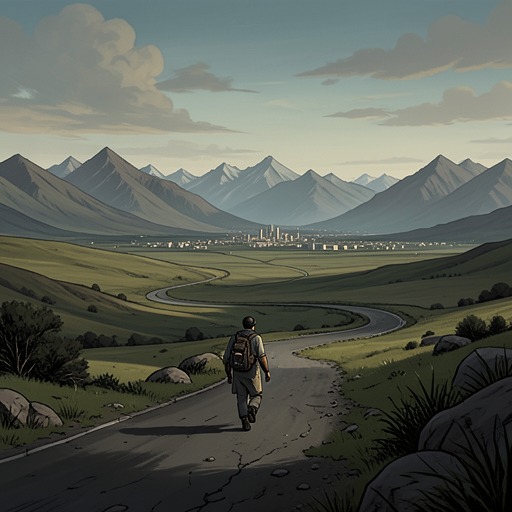
Montana Slim, who has proposed exploring Cheyenne together, is still present after the truck leaves. By morning, however, he has gone, apparently continuing toward Montana. Sal wakes with a headache, sees the snowy tops of the Rocky Mountains in the blue air, eats a modest breakfast, and leaves the festival behind. He takes the highway that runs nearest the mountains and catches a ride toward Denver. In this sequence Cheyenne is not his destination but the place from which he reorients himself: the celebration recedes, the mountains become his guide, and the search for his Denver friends resumes.
Cheyenne in the Stories of the Road
The novel’s wider road narrative gives Cheyenne a life beyond Sal’s first arrival. Before the festival, Big Slim is described as a man known around the Cheyenne yards for flattening a policeman with one punch, a reputation that fits the tough, mobile world of rail yards and highway travelers. Later, a man headed to see his father in Montana says he will have to leave a rig at Cheyenne and continue north another way. Such passing references make the town a practical interchange for travelers whose routes split between north, south, and west, not merely a symbolic gateway that exists for Sal alone.
Cheyenne also belongs to the larger network of journeys that the novel repeatedly traverses. Sal’s 1947 passage west follows the imagined pull of the map and the actual contingencies of rides, while subsequent travel revisits familiar stretches of the country. On a later drive, Sal recognizes Newton and Davenport from his earlier trip; the road across Illinois makes the dry West feel accomplished and brings the travelers back toward the softer East. The return does not erase the first crossing. Instead, repeated movement turns towns and routes into layers of lived memory, so that a place can be both an immediate stop and a marker of how far the travelers have come.
A Threshold Between Myth and Movement
Cheyenne’s narrative importance rests on the tension between an inherited image of the West and the unromantic arrangements of road travel. Wild West Week offers the hats, guns, saloons, and wooden sidewalks of a popular frontier spectacle, but the scene also exposes that spectacle as something staged for visitors. Beyond it, Sal’s journey depends on rides, decisions about direction, a night in town, and a new hitchhike toward the mountains. The apparent freedom of the open road is inseparable from fatigue, money, weather, and reliance on strangers.
That tension recurs in the way the novel maps American space. Sal’s early plans are shaped by lines on a road map and stories of pioneers; on the ground, the route keeps changing with the people who can carry him. Cheyenne is one of the points where an imagined national landscape meets its practical infrastructure: a town, a stopping place, a crossroads, and the end of one ride. It does not complete Sal’s westward quest. It redirects it, leaving the festival behind and setting him on the road toward Denver.